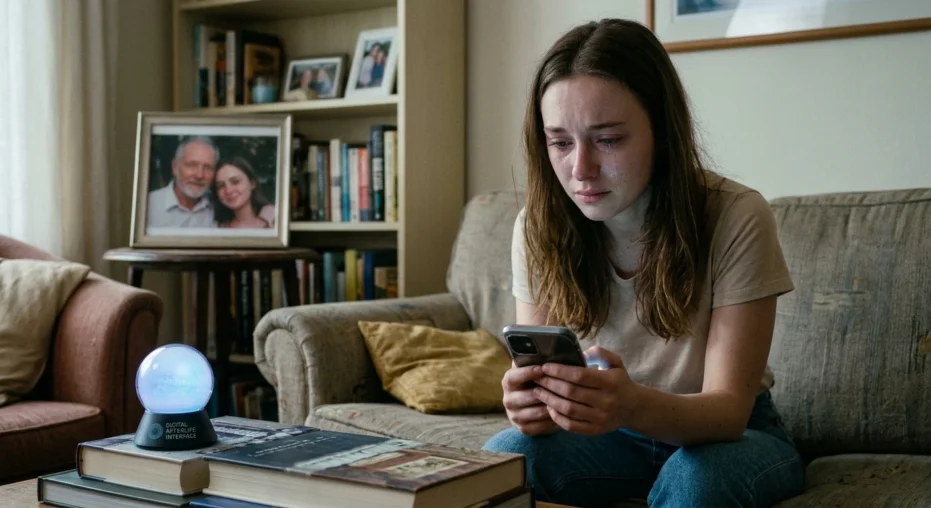
Imagine receiving a text message from your father, who died five years ago.
Not an old message that somehow got lost in cyberspace, but a brand-new one. He asks how you’re doing, remembers your birthday, and makes the same terrible jokes he used to make when he was alive.
You reply, and he answers.
Then you decide to call him. You hear his voice, the familiar expressions, even the little pauses he used to make between sentences.
It’s enough to give you the creeps.
But there’s no ghost involved. At least, not in the traditional sense.
You’re talking to a deathbot, and thanks to artificial intelligence, this rather unsettling technology is already with us.
So, what exactly is a deathbot?
A deathbot is an artificial intelligence system designed to imitate someone who has died.
You might also hear the terms griefbot, ghostbot, deadbot, or digital afterlife avatar. They all refer to roughly the same idea: using someone’s digital history to recreate aspects of their personality, voice, or appearance after death.
Think about the enormous amount of information we leave behind these days.
Emails, text messages, Facebook posts, photographs, videos, voice recordings, and years of online conversations.
Taken together, these can reveal quite a lot about a person. How they spoke, what they believed, their sense of humour, their relationships, and the things that mattered to them.
AI can use that information to produce a digital imitation of the person.
And unlike a photograph or an old home movie, some of these imitations can actually hold a conversation with you.
You ask a question, and the system generates a response that sounds like something the deceased person might have said.
The important word here is might.
Because no matter how convincing the conversation becomes, the person you’re speaking to isn’t actually there.
Or at least, there’s no credible scientific evidence that they are.
The idea has been around longer than you might think
If you’re a fan of Black Mirror, you might remember the 2013 episode “Be Right Back”.
In it, a grieving woman uses an online service to communicate with an AI version of her deceased boyfriend. Initially, the system exchanges messages with her, but things become increasingly disturbing as the technology develops.
It was a clever and uncomfortable piece of science fiction.
A few years later, something remarkably similar happened in real life.
In 2015, a young Russian entrepreneur named Roman Mazurenko was killed in a road accident.
His close friend, Eugenia Kuyda, struggled with his death. She eventually collected thousands of his text messages and used them to create a chatbot capable of responding in his style.
The results were surprisingly convincing to some of Roman’s friends and family.
Not everyone was comfortable with the idea, however. Some found it disturbing that a computer program was essentially speaking on behalf of someone who could no longer speak for himself.
The story was documented in a fascinating 2016 article in The Verge, When Her Best Friend Died, She Used Artificial Intelligence to Keep Talking to Him.
It remains one of the best early examples of the emotional and ethical problems surrounding deathbots.
And the technology has advanced considerably since then.
Companies are already selling versions of a digital afterlife
Today, several companies offer services that allow people to preserve their voices, memories, and personal histories for future generations.
Family members can later ask questions and hear answers based on those recordings.
One of the early companies in this field was HereAfter AI, which allowed people to record their life stories and preserve their voices so family members could listen to their memories after death.
But there’s an interesting twist to that story.
HereAfter AI shut down in 2026. The company announced its closure in July, and by August its website was no longer accessible.
According to reporting on the shutdown, customers were directed to contact the company to retrieve their recordings.
Think about that for a moment. People entrusted a company with recordings of their loved ones, believing those memories would remain available for years to come. Then the company closed.
It’s a rather uncomfortable reminder that digital immortality depends on something decidedly mortal: a business remaining in operation.
StoryFile takes a somewhat different approach, using recorded video responses to create interactive conversations. Rather than generating entirely new statements, its technology can retrieve answers the person actually recorded.
That’s an important distinction.
A system that plays your grandmother’s recorded answer to a question about her childhood is preserving something she genuinely said.
A generative deathbot that invents an answer to a question she was never asked is doing something quite different.
Both might sound convincing. Only one is necessarily giving you her actual words.
Researchers have started examining this distinction. A study published in Memory, Mind & Media looked at several digital afterlife platforms and questioned what happens when preserving someone’s memories becomes a commercial product.
It’s an interesting problem.
Are these companies preserving our personal histories, or are they selling people the illusion that their loved ones are still around?
Perhaps a bit of both.
How does a deathbot actually work?
The technology isn’t particularly supernatural, although the results can certainly feel that way.
A deathbot generally works by combining personal information with AI software capable of generating text, speech, or images.
First, the system needs information about the deceased person.
This could include years of text messages, emails, social media activity, recorded conversations, videos, and photographs.
The more relevant information it has, the better its chances of producing an imitation that feels familiar.
Next, an AI model uses that material to generate responses.
It might reproduce someone’s favourite expressions, imitate their sense of humour, or refer to events from their past.
More sophisticated systems can add voice cloning and animated video.
The result could be a digital representation that looks and sounds remarkably similar to the original person.
But there’s a catch.
AI doesn’t need to know the correct answer to produce a convincing one.
Suppose you ask a deathbot what your late mother thought about your decision to move overseas.
If she never discussed the subject, the AI might still give you an answer.
It could sound exactly like something she’d say.
It could also be completely wrong.
And that’s where the technology starts to become uncomfortable.
You’re no longer simply preserving someone’s memories. You’re creating new opinions, conversations, and potentially even experiences on their behalf.
We’ve previously looked at how AI can enhance paranormal investigations and research. The same ability to recognize patterns and process large amounts of information can be useful in investigative work.
But AI-generated responses need to be treated carefully. A computer can produce an answer that sounds convincing without that answer being true.
That matters when you’re examining paranormal evidence.
It matters even more when the computer is pretending to be your dead mother.
Could deathbots actually help people deal with grief?
This is probably the most complicated part of the whole subject.
People have always found ways to maintain connections with loved ones after death.
We keep photographs, save voicemails, preserve handwritten letters, and visit graves.
Some people regularly speak aloud to deceased relatives. Others find comfort in dreams or experiences they interpret as signs that someone is still around.
There’s nothing particularly new about wanting to maintain a connection with someone we’ve lost.
What’s different about deathbots is that the connection can appear to be two-way.
Instead of remembering what someone once said, you’re receiving new responses in their voice.
For some people, that might be comforting.
Imagine an elderly woman being able to hear her late husband’s voice again, or a child being able to ask questions about a parent who died when they were very young.
There could be genuine value in preserving memories this way.
But what happens when someone becomes emotionally dependent on the technology?
Could regularly speaking with an AI imitation make it more difficult to adjust to a loved one’s death?
Or could it provide comfort without interfering with the grieving process?
We don’t yet have enough long-term evidence to give confident answers.
In a 2024 academic paper titled On Grief and Griefbots, Oxford researcher Cristina Voinea explored whether digital recreations of deceased loved ones might help people grieve or complicate that process.
It’s a question worth taking seriously.
And there’s another possibility that doesn’t get much attention.
What happens if the company operating your loved one’s deathbot goes out of business?
Imagine spending several years speaking regularly with a digital version of your wife, only to discover that the service will be discontinued.
You could effectively lose her all over again.
Except this time, the loss would be caused by a business decision.
The ethical questions get pretty uncomfortable
Let’s say your brother dies.
You have access to his emails, text messages, photographs, and voice recordings.
You decide to create a deathbot so that you can continue speaking with him.
Fair enough. But what if your brother would have hated the idea?
What if his wife doesn’t want you doing it?
Or what if the AI begins saying things that are completely out of character?
Who gets to decide what happens to someone’s digital identity after they die?
These aren’t questions that technology companies should be answering on their own.
Researchers at the University of Cambridge addressed some of these concerns in a 2024 paper titled Griefbots, Deadbots, Postmortem Avatars: On Responsible Applications of Generative AI in the Digital Afterlife Industry.
The authors examined several troubling possibilities, including unwanted digital recreations, commercial exploitation, and the emotional effects of interacting with an AI version of someone who has died.
One of their fictional scenarios involved a deathbot incorporating advertising into conversations.
Imagine asking your deceased grandmother for her spaghetti recipe and having her digital imitation suggest ordering dinner from a particular delivery company.
It sounds absurd.
But it’s a useful example of what could happen when personal grief becomes a business opportunity.
The researchers recommended safeguards, including meaningful consent, transparency about the technology, and ways for people to retire a deathbot without unnecessary distress.
After all, there’s something deeply unpleasant about the idea of a company controlling whether you can continue talking to a digital version of someone you love.
What does any of this have to do with ghosts?
Quite a lot, actually.
For centuries, people have reported hearing voices, seeing apparitions, and receiving messages they believe came from deceased relatives.
Some of those experiences are intensely personal.
Others have become the subject of formal paranormal investigations.
Today, however, we have technology capable of recreating the appearance and voice of almost anyone, provided enough suitable material is available.
That creates a new problem for people investigating claims of communication with the dead.
Imagine someone posts a recording online.
It’s supposedly a message from their deceased father. His voice is recognizable, he uses familiar expressions, and he refers to private family information.
Twenty years ago, that recording might have attracted considerable interest among paranormal enthusiasts.
Today, investigators would need to consider whether it was generated using AI.
And the same applies to video.
A lifelike recording of a deceased person speaking is no longer particularly strong evidence of anything supernatural.
It might simply be a convincing digital imitation.
This doesn’t disprove paranormal phenomena, of course.
But it does mean that investigators need to be much more careful about what they accept as authentic evidence.
Deathbots, EVP recordings, and the problem of hearing what we expect
There’s another interesting connection between deathbots and traditional paranormal research.
Electronic Voice Phenomena, usually called EVP, involve sounds captured on recordings that some investigators interpret as voices from spirits.
We explored the subject in our article Electronic Voice Phenomenon (EVP): Sounds from Beyond.
EVP recordings have always been controversial.
One of the biggest problems is that people can hear words and phrases in ambiguous sounds, particularly when someone tells them what they’re supposed to hear.
This is an example of auditory pareidolia.
Think about the last time someone played a muffled recording and said, “Listen carefully. He’s saying ‘get out’.”
Once you’ve heard that suggestion, it can be surprisingly difficult to hear anything else.
AI adds another complication.
Modern audio software can remove background noise, separate sounds, and attempt to reconstruct unclear speech.
These are useful capabilities, but some AI processing systems can also generate or alter details that weren’t clearly present in the original recording.
If an investigator uses AI to enhance a questionable EVP, the resulting voice may sound clearer without necessarily being more accurate.
Now combine that with voice-cloning technology.
Someone could potentially create a convincing recording of a deceased person saying words they never spoke.
The result might be indistinguishable from a paranormal message to someone who doesn’t know how it was produced.
This also raises questions about devices used in spirit communication.
In our article What Is a Spirit Box and How Does It Work?, we explain how spirit boxes scan radio frequencies and produce fragments of speech that some investigators interpret as responses from spirits.
Whether it’s a spirit box, an EVP recorder, or an AI deathbot, one question should always come first:
Where did the voice actually come from?
Before assigning a supernatural explanation to a recording, investigators should establish its origin, preserve the original file, document any processing, and consider ordinary explanations.
Without that information, even a remarkably convincing voice tells us very little about its source.
Are we creating a new kind of ghost?
There’s an interesting parallel here with traditional ghost stories.
For centuries, people have described apparitions that seem to remain tied to particular places, events, or memories.
Some paranormal theories suggest that certain hauntings involve impressions of past events rather than conscious spirits.
We’ve discussed a related idea in The Mysterious Phenomenon of Paranormal Looping, where apparently repeated events are interpreted by some investigators as echoes of the past.
A deathbot isn’t a residual haunting, obviously.
But the comparison is interesting.
Both involve something that appears to preserve aspects of a person after they’re gone.
The difference is that with deathbots, we know the mechanism involved.
The information comes from recordings, messages, photographs, and computer systems.
There’s no need to invoke the supernatural to explain why a deathbot can sound like someone who died years earlier.
Yet the emotional experience could still feel remarkably similar to what people describe during alleged ghostly encounters.
Hearing a familiar voice when you know the person is dead can be an extraordinary experience.
Even when you know perfectly well that the voice is coming from a computer.
Could deathbots become the next big thing?
Possibly.
The technology behind them is becoming more capable, and people are increasingly comfortable using AI in everyday life.
It isn’t difficult to imagine a future where recording a digital version of yourself becomes as ordinary as writing a will or preparing family photographs.
Perhaps people will create interactive autobiographies that allow their grandchildren to ask questions decades after they’ve died.
Perhaps funeral homes will begin offering digital memorial services.
Or perhaps the technology will remain something that most people find too uncomfortable to use.
There are good reasons to be cautious.
A digital memorial that preserves someone’s actual words and memories could be a wonderful resource for future generations.
But a generative AI system that starts inventing their opinions, giving personal advice, or expressing emotions on their behalf is something else entirely.
The distinction matters.
Because at some point, the system stops preserving a person’s history and starts creating a fictional version of them.
And if that fictional version sounds exactly like someone you loved, it could be very difficult to separate the two.
What do you think? Would you use a deathbot to communicate with someone you’ve lost, or is this one technological development you’d rather leave alone?
Sources and further reading
- Casey Newton, The Verge (2016). When Her Best Friend Died, She Used Artificial Intelligence to Keep Talking to Him. An account of Eugenia Kuyda’s attempt to recreate her deceased friend using AI.
- Hollanek, T. and Nowaczyk-Basińska, K. (2024). Griefbots, Deadbots, Postmortem Avatars: On Responsible Applications of Generative AI in the Digital Afterlife Industry. Philosophy & Technology. Research exploring ethical risks and safeguards for AI recreations of deceased individuals.
- Voinea, C. (2024). On Grief and Griefbots. Think, Cambridge University Press. A philosophical examination of deathbots and grieving.
- Synthetic Afterlives: Deathbots as Affective Infrastructures of Memory (2025). Read the study. Memory, Mind & Media. Research examining digital afterlife platforms and the commercialization of personal memories.
- StoryFile. Official website. Interactive video technology that allows users to engage with recorded interviews.
Enjoy exploring the unexplained? Subscribe to The Paranormal Bulletin for paranormal research, unusual stories, investigation techniques, and the latest developments from around the world. You’ll also receive our free guide, 40 Questions to Ask During a Paranormal Investigation.